
Growing Food at Altitude and in Short Seasons: Beds, Hoops, and Timing


Photo by Alois Lackner
Yvette Henson gardens at 8,400 feet in southwest Colorado, where she also works as Colorado State University Extension's director for San Miguel County, and her garlic came up small. She had hoped to pull it on the first of July and plant peas behind it. The garlic was not ready until the middle of the month, and it was small besides. Her 'Candy' onions, planted May 14, taught the sharper lesson: the ones she set out as started plants went on to form bulbs, and the ones she direct-seeded stayed small. Same bed, same day, same gardener. The difference was timing, and at 8,400 feet timing is nearly the whole game.
Her season explains why. Daytime highs at her elevation usually stay at or under 80 degrees, nights run near 50, and the frost-free stretch she works with is, by her own estimate, about 100 days. Colorado State University's mountain gardening fact sheet, written for exactly her conditions, puts the general case plainly: many Colorado mountain sites get fewer than 90 frost-free days, and the county extension office in Gilpin County, at 9,300 feet, averages a last frost on June 10 and a first frost on September 15. A gardener who moves up a mountain does not get a shorter version of the lowland season. She gets a different problem, and it has three separate parts: cold air, cold soil, and not enough accumulated heat. Each part has its own tools, and confusing them is how mountain gardens fail.
The arithmetic of altitude
Start with the ruler. Temperature falls about 3.5 degrees Fahrenheit for every thousand feet of elevation gained, a figure Colorado State University Extension uses in its mountain gardening guidance and the standard lapse rate in meteorology. A garden at 8,400 feet therefore runs roughly 10 degrees cooler than one at 5,400 feet in the same valley system. Frost dates follow the temperature down. That is the first part of the problem, and it is the only part most advice mentions.
The third part is quieter and decides more. Plants do not grow by the calendar; they grow by accumulated warmth, which agronomists count in growing degree units. Colorado State's fact sheet works the Gilpin County numbers in full. A typical summer day there, 79 degrees by day and 45 at night, yields about 12 degree units. The whole summer yields about 1,000. An ultra-early tomato, the 'Siberian' and 'Arctic' types bred for exactly this work, needs about 1,100 degree units to ripen its first fruit. Extra-early corn needs about 1,870. Read those three numbers together and the classic mountain disappointment stops being a mystery: the tomato plants grow tall and green, the frost arrives in September, and not one fruit has ripened. The season was long enough. It was not warm enough, which is a different shortage, and no amount of wishing at the seed rack fixes it. The honest responses are to add warmth with covers and warm soil, and to choose varieties whose heat bill the site can actually pay.
Cold soil is the second winter

Air temperature gets the attention, but seed sits in soil, and cold soil stops germination cold. Oregon State University Extension's soil-temperature table, compiled by J. F. Harrington, gives the minimums: lettuce and spinach will germinate at 35 degrees, carrots and peas at 40, tomatoes and corn at 50, and beans, peppers, and squash hold out for 60. The same table shows what cold soil does to a warm crop that is sown anyway. A tomato seed in 50-degree soil takes about 43 days to emerge. In 77-degree soil it takes 6 days. In a 90-day season, a tomato that spends 43 days underground has spent half its life before it has a leaf.
So mountain gardeners plant by the thermometer, not the calendar. Colorado State's rule is direct: sow frost-tolerant crops outdoors about 4 weeks before the last frost, or when the soil six inches down reads 40 degrees at eight in the morning. Warming the soil is therefore the first real work of the season. Raised beds earn their keep here before anything is planted in them. A bed lifted out of the ground catches sun on its sides and drains instead of sitting wet, and wet soil stays cold; extension guidance puts raised beds ready to plant roughly 1 to 2 weeks ahead of in-ground beds in spring. A bed piled on a south-facing slope warms faster still, for the same reason a south wall does. Dark plastic mulch laid tight over a bed adds roughly 5 degrees at 2 inches down in daytime, according to extension measurements, which can pull a planting a week or two earlier. The full heat treatment is clear plastic, which warms soil more than black but grows weeds under itself, so most growers take the black plastic trade. None of this is decoration. At altitude, soil warmth is season length, bought in degrees instead of weeks.
Beds, frames, and cloches: the small tools

The raised bed has one more mountain virtue that has nothing to do with temperature. Colorado State's fact sheet advises laying quarter-inch hardware cloth under beds where voles and gophers work, because a short season has no slack for replanting a bed that was eaten from below. Build the defence into the bed while it is empty.
Above ground, the smallest season-stretcher is the cold frame, a bottomless box with a sloped glass or clear lid, and its even smaller cousin, the cloche. Colorado State describes the milk-jug version: cut the bottom off a translucent jug, set it over a young plant, and leave the cap off so the plant does not cook. A cold frame over a raised bed does the same work for a whole row of seedlings and gives transplants a halfway house between the windowsill and the open garden, which matters for reasons the timing section below takes up. These are humble tools. They are also the difference between a seedling surviving its first mountain week and not.
Hoops and covers: buying weeks at both ends
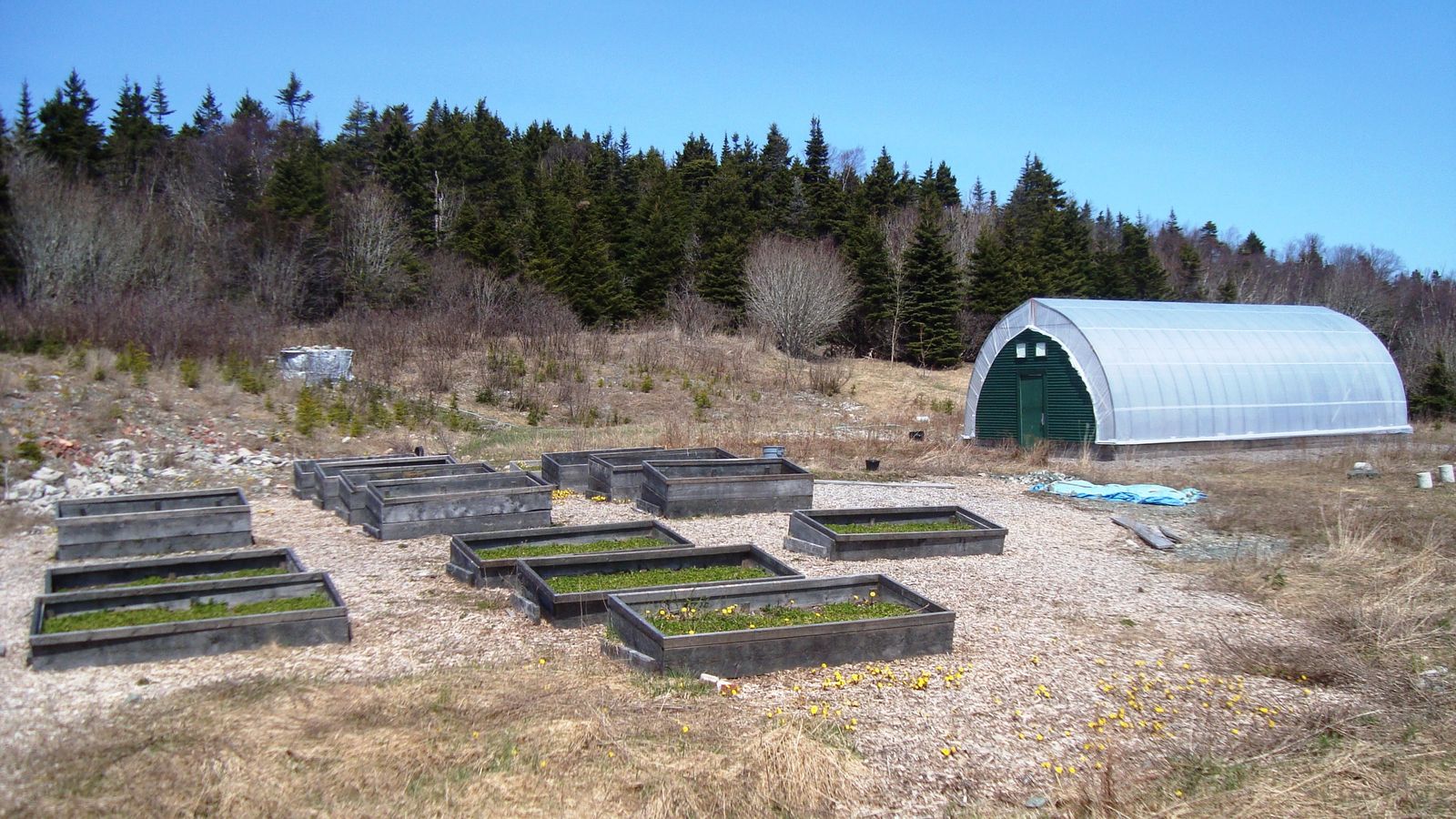
The tool that changes the arithmetic is the hoop. Bend half-inch PVC pipe, conduit, or heavy wire into arches over a bed, space them 3 to 5 feet apart depending on how much wind the site takes, and what goes over them decides how much season they buy. Colorado State University's season-extension guidance grades the covers by result. Floating row cover, the light fabric laid over hoops or directly on the crop, protects plants down to about 24 degrees depending on the fabric's weight and gains a couple of weeks at each end of the season. The heavier frost blankets gain a week or two beyond that. A low tunnel of plastic film over hoops gains about a month at each end. In Colorado State's Fort Collins trials, plastic over a frame typically gave 3 to 6 degrees of frost protection and added 2 to 6 weeks or more at both ends of the season. A hoop house you can walk into is a bigger step again: Cornell Cooperative Extension's vegetable specialists in New York's North Country put the climate inside a high tunnel at 1 to 2 full USDA hardiness zones warmer than the ground outside it, and Cornell's Willsboro Research Farm trials found some crops yielding up to 4 times as much inside as out. That is the tool Lissa Goldstein farms with at Wild Work Farm in Keene Valley in the Adirondacks, where the last frost can come in mid-June and the first in September.

One line of orientation, because the tools get confused: a hoop house is not the glass greenhouse front that heats a house, which another article in this series covers on its own ground. A hoop house is cheaper, flimsier, and aimed only at the crop. Eliot Coleman built his four-season system at Four Season Farm in Harborside, Maine, on exactly that humility: low hoops over 30-inch beds, a layer of row cover over the plants, and greenhouse plastic added over the top of that when winter came, two cheap layers doing together what one expensive wall of glass does elsewhere.
What covers do wrong

Covers fail in three ways, and each failure is documented by the same extension services that recommend them. The first is heat. A closed plastic cover in direct sun can pass 130 degrees within an hour, Colorado State's GardenNotes warn, cooking the plants the cover was protecting. Venting is not optional and it is daily: at least a slit opened every sunny morning. The same GardenNotes record the flip side, a space blanket laid over plastic holding plants unfrozen through a night that hit zero outside, but only because the blanket came off each day so the soil could soak up sun and recharge.
The second failure is wind. Row cover secured with clothespins will not stay on a windy site; Colorado State advises staples, rebar, logs, or rocks, with edges buried or weighted and proper clips where the fabric meets the hoop. Mountain wind is not an edge case. It is the climate. The third failure is snow, and it is structural. The University of Vermont Extension's guidance on hoop house snow load puts a figure on it: each inch of rain's worth of snow weighs about 5.2 pounds per square foot, which adds up to roughly 6.5 tons on a 25-by-96-foot house. A foot of light snow holds about an inch of rain; 3 or 4 inches of wet snow holds the same. Evenly spread snow is rarely what falls. Wind drifts it, and the uneven load is what folds houses, with the ridge of a Quonset shape the weakest point. The extension advice is to prop the ridge with posts before the storm, clear snow as it comes, and, if the load wins anyway, cut the plastic and let the snow fall inside. A dead frame costs a structure. A cut sheet costs a sheet.
Timing: the season is won indoors

With warmth added by beds and covers, the remaining lever is when things start, and this is where Henson's onions give their lesson. A direct-seeded onion and a transplanted onion planted the same May day are not the same age. The transplant had weeks of warm indoor life the seed never got, and in a 100-day season those weeks are the crop. Colorado State's planting calendar for the mountains runs on that logic throughout: broccoli, cauliflower, leeks, and Brussels sprouts sown indoors 6 to 8 weeks before the last frost and set out 2 weeks before it; tomatoes started indoors under lights at least 6 weeks ahead; frost-tolerant seed sown outside a month ahead of the last frost date.
Two disciplines protect the head start. The first is hardening off. A seedling raised in a still, warm room that is set straight into mountain wind and 45-degree nights will stunt, sulk, or die, which is why extension and seed-house guidance agree on a gradual introduction to outdoor life spread over a week or two before transplanting, and on setting plants out in the evening or on a cloudy day rather than into midday sun. The second is respect for fragile roots. Squash and its relatives resent transplanting, so Colorado State advises starting them in biodegradable pots that go into the ground whole, pot and all, rather than tearing roots out of a tray.
Then there is the seed packet itself. The days-to-maturity figure on a packet counts from transplanting, not from sowing, and as Colorado State warns, those figures were established in warmer climates and run longer in the mountains. The practical rule from growers who live with it is to shop by the number and stay under a ceiling. Linda Ly, who gardens in Central Oregon and writes as Garden Betty, reports about thirty frost-free days in an ordinary year of hers and sixty in a good one, with freezes possible in July. Her answer is varieties bred short and cold-hardy: 'Sub-Arctic Plenty' at 42 days, bred in Alberta; 'Siberia' at 50; 'Glacier' and the Czech 'Stupice' at 55; 'Oregon Spring', bred at Oregon State University, at around 58 to 65. Her working rule is tomatoes at 70 days or less, smaller fruit and determinate habits over the big indeterminate vines, and she still reports around 25 pounds of fruit from a strong plant in a good year. Underneath variety choice runs the simplest timing tool of all: succession. Colorado State advises sowing quick cool-season crops, the lettuces, spinach, and radishes that mature in 25 to 60 days, in small batches about every 2 weeks, so the harvest comes in waves sized to the season instead of one gamble on a single sowing.
Microclimates: the free weeks

The last tool costs nothing, because it is the site itself read properly. Cold air flows downhill at night and pools in low ground, so the flattest, lowest part of a mountain property is often its frost pocket, while a gentle mid-slope and the ground against a south-facing wall run measurably warmer. Colorado State's fact sheet makes the point directly: valleys are frequently colder at night than the hillsides above them. A wall stores the day's sun and hands some of it back after dark, and a bed set against one is in a different climate from a bed 50 feet away in the open. Henson uses the same principle at kitchen scale. Her short-season tomatoes grow in buckets on her deck, the warmest microclimate she has, where the house wall and the deck boards do the work a heater would. Site the tender crops where the warmth already collects, and put the peas and kale, which shrug at frost, in the cold hollow.
Water and wildlife close the site audit. Colorado gardeners on wells need to check what their well permit allows before they plan irrigation at all: Colorado State warns that wells drilled after May 2, 1972 on parcels under 35 acres may carry no right to water outdoors, and its own demonstration garden in Gilpin County has run since 2008 on drip lines fed by rainwater, where a quarter-inch of rain on 1,000 square feet of roof yields about 150 gallons. Deer take the other tax. Colorado State sets the fence standard at 8 feet, or two 4-foot fences set 4 feet apart, because a deer will not jump what it cannot land in.
Henson's aim, as she tells it, is to disprove the sentence she hears from neighbours: "You can't grow a garden up here." She does not disprove it with a miracle crop. She disproves it the way this whole method works, in pieces: onions transplanted instead of seeded because the season is too short for both to work, tomatoes in buckets on the warm deck instead of in the cold ground, greens traded downhill for squash from gardens with heat to spare, and garlic measured against July honestly when it runs late. The stake at altitude is not a slightly smaller harvest. It is the whole harvest, decided by whether the grower counted the heat before planting, warmed the soil before sowing, and spent the short season only on what the arithmetic said it could finish.